As Spring wanes into Summer and the outdoors become a beckoning wonderland with so much “scope for the imagination,” we are in it as much as we can reasonably be. The children and my husband more so. I have little tolerance for the mosquitoes, black flies and horse flies. However, this year has been cooler and the dragonflies came early this year, so I’ve enjoyed the outdoors in May and June more than in previous years. It has been fun to see the bulbs I planted last Fall coming up for the first time and to discover new growth in our yard—like the beautiful beds of clover among the grass and different, colourful varieties of grass in the field that were not there last year. In addition, we have more birds this year than last. I haven’t learned all their names yet, but you would think we live in a bird sanctuary by the constant sounds in the trees and fields which go on, almost uninterrupted, 24 hours a day!

One of the chief delights of the last few weeks has been the discovery of countless toads and frogs residing in the window wells. My children have transformed a ditch which runs along one side of our property into a kind of amphibian resort. They lined it with a large piece of tarp and filled it with water. This is “the pond.” Two big, black, heavy-duty bins are the “hotels” where they keep the creatures until they’re ready to bring them to the water. Each bin is filled with water and sand, to make a kind of beach. Then on go the hoses and the Pond is filled up and the frogs and toads are carefully brought out. Ramps have been set up for slides; waterfalls are sometimes set up for added amusement. I even witnessed one fat toad being sent down the ramp on the back of a toy tractor. I am told that, on a previous run, “he actually held on to the steering wheel!”

And so, imaginations have been running wild around here. I know the outdoors help, but thank goodness there are other things which spark our minds. Especially in these days of self-isolation when so many people may not have the blessing of space we do, there is always the large space provided by books. Are you and your family reading more? Are the vistas opening? The mind cannot be willingly isolated and confined. That got me thinking about something I recently read as I very slowly comb through Volume One of Charlotte Mason’s beautiful treatise on education entitled Home Education. She goes through the various habits which we should be trying to cultivate in ourselves and our children. These include the habits of attention, application, thinking, remembrance, obedience and truthfulness. Embedded in this list is one I found curious but fascinating: the habit of imagining.
In this section, she makes the observation that “it is a pity when the sense of the ludicrous is cultivated in children’s books at the expense of better things.” I think of the times I’ve taken my children to the library and had to gently steer them away from books which are noticeably mere candy, or “twaddle”, as Mason calls them: books of little substance with absurdity tripping over absurdity and not even a moral lesson to make the read worthwhile. There are those books, but there are more well-known and well-loved books which could fall under the category of cultivating “the sense of the ludicrous.” Mason notes that “Alice in Wonderland is a delicious feast of absurdities, which none of us, old or young, could afford to spare; but it is doubtful whether the child who reads it has the delightful imaginings, the realising of the unknown, with which he reads The Swiss Family Robinson.”
We certainly love the nonsense genre around here. Edward Lear’s silly rhymes and Rudyard Kipling’s Just So Stories are just so much fun. And “they must have ‘funny books’” Mason goes on, “but do not give the children too much nonsense reading.” I think I’m beginning to understand why. Do you have the same problem at your home? Do your children go into “silly mode” at the worst times: say, for instance, when your Parish priest is over for supper (it was two years ago and I’m still blushing!); or at the end of a long day when you could use a quiet, civilized supper, but all you hear is raucous laughter over some inside joke from some nonsense they’ve been imbibing? Do “the sillies” (as they’re known around here) come replete with voices (say, Russian or French Canadian accents), or oddly chanted words in tones unrecognizable? Do your children seem to be tottering on the brink of insanity in those moments? Can you begin to imagine what the famous Mad Hatter’s tea party was really like? Suffice to say, we fight a daily battle around here with “the sillies” and that’s sans T.V. and movies, so my children don’t even have access to the breadth of visual and audio nonsense currently passing for children’s entertainment.
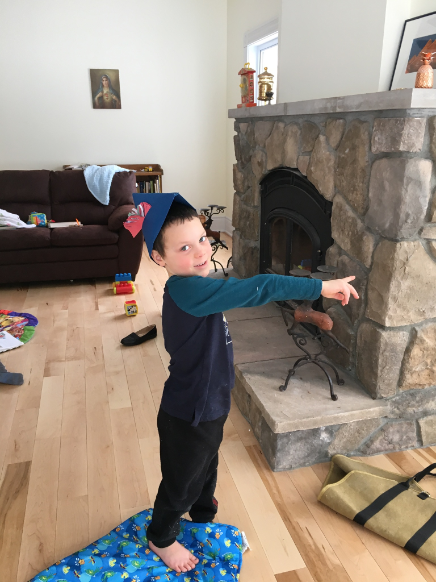
But what does fire their imaginations? It’s been wondrous to see their imaginations unfolding this past year. It began with my second son’s obsession with Rapunzel. He was the prince and towers were erected all over our home with chairs and cushions. How thrilling to encounter the witch instead of Rapunzel on that last fateful day when the prince ascends the tresses. The witch enthralled all the children and when they encountered an even more scary one in Hansel and Gretel, they were off on that story, poring over the passages where the children stand nibbling hungrily at the house. Every time I read it (and I’ve lost count how many times I did!), I could see and sense their growing anxiety as the children break off piece after piece and then, suddenly, the witch is at the door. “Please don’t speak in her voice!” my John would cry out, even as he smiled through delicious fear and held onto my arm wanting to hear the voice. From there, we were swept into world of Robert McCloskey’s Make Way for Ducklings and the children fell in love with Michael, the portly policeman, and Mr. and Mrs. Mallard who work so hard to find a home for their precious ducklings: Jack, Kack, Lack, Mack, Nack, Ouack, Pack and Quack.

However, more than anything we’ve read this year, one series has consumed my children: the Little House books by Laura Ingalls Wilder. Mason says: “let them have tales of the imagination, scenes laid in other lands and other times, heroic adventures, hairbreadth escapes, delicious fairy tales in which they are never roughly pulled up by the impossibile—even where all is impossible, and they know it, and yet believe.” I think it is precisely this sense of another world and another time, not to mention the heroic adventures of the amazing Ingalls family which have so captured their hearts and minds. These types of stories are precisely the ones that children will want to “live over and over, and ‘play at’ by the hour,” Mason continues. This has certainly been the case in our home. Each family member has been assigned a particular character from the novel and we are all encouraged to play at “Little House” by the hour. The couch is often turned into the wagon, complete with feed boxes and places for Mary and Laura and baby Carrie to lie down in the back. Ma and Pa sit up top, both with homemade whips in hand and a little stuffed dog gets tied to the couch leg to represent Jack, the faithful bulldog. These are serious games. If anyone else claims to be Pa, for instance, my John—often mild-mannered—will retaliate. But I’m happy for him to play at Pa if it means that he eats his beans (because Pa would eat his beans); or if it means that he doesn’t fight with his sister (who is Ma), because Pa would never fight with Ma. Virtue weaves itself into our lives through stories.

Through the Little House books, we have delved into questions about the indigenous populations of North America, the American Civil War, the development of technology, proper conduct at table, geography, weather patterns and vocabulary, the relationship between parents and children, discipline, modesty, courtesy, perseverance, industry, and a host of other topics which have come up in their growing minds, pressing into their consciences and requiring explanations. The Ingalls and the Wilders have become living people, our family friends, people we can relate to and admire. Such is the treasure of a good book.

How many books have formed you as a person? I can think of the ones which made me into the person I have become—and none of them relied on the “sense of the ludicrous” for entertainment value. They are the books I returned to time and again, the ones that made a deep impression, the ones I want to share with my children: Montgomery’s Anne books, Little Women, Jane Eyre, all of Austen, The Lord of the Rings, the Narnia books, Dickens’ novels, and so many others. They have formed my imagination, but also my heart and my soul.
For many adults, real life takes over at some point and we forget the world of the imagination—often until we have children of our own or other people’s children around us to remind us of this vital aspect of our selves. Perhaps Summer is a good time to think of cultivating our imaginations. It’s a time when imaginations can tend to run free and unguarded, when it is so much easier to reach for the nonsensical, the ludicrous, the mere fluff. Certainly, these types of books have their place, but they cannot constitute our entire diet. Perhaps it is worth it to challenge ourselves to find a couple of really good books to spend time with this year—new or old favourites—which will help us enter into the lives and times of other people in order to appreciate our own lives and times with greater gratitude, or simply to understand them better. In doing so, we grow and have more to offer to those around us. And maybe as we form or reform our tastes, we will be able to choose more wisely for our children’s fare. There are so many wonderful stories just waiting to be discovered and lived out! I hope to share a few titles in my next post, so stay tuned!


All the joys that nature and simple habits bring! Thanks for bringing us such beautiful updates on your farmstead.
LikeLike